
Control Energy at the Source
Automate HVAC and lighting schedules, setpoints, and operating modes to help reduce unnecessary energy use.
U.S. MARKET OVERVIEW

Bisly helps building owners modernize their properties through intelligent building automation.
By optimizing energy consumption and centralizing building controls, Bisly can help you:
Improve building energy performance to support compliance with local emissions and efficiency regulations.
Reduce unnecessary HVAC and lighting consumption through intelligent automation.
Qualifying building automation upgrades may be eligible for utility rebates and energy-efficiency incentives, reducing upfront investment.
Explore how regulations, energy costs, and available incentives affect your market.
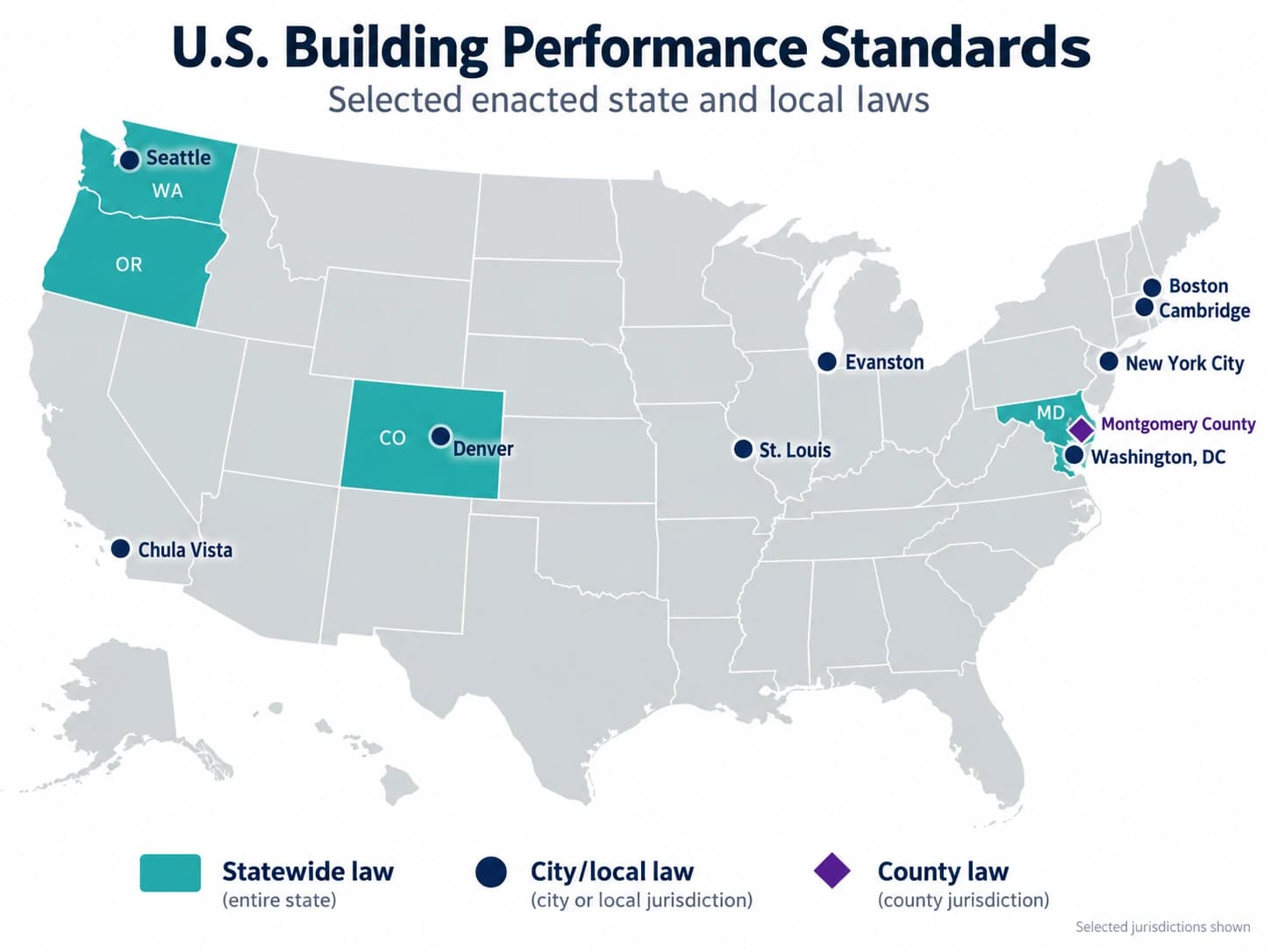
For building owners, modernization is no longer just a technology decision. Local regulations can set performance targets, energy prices determine the value of efficiency, and available incentives may help offset project costs. Select a topic to see how these factors differ by market.
Some jurisdictions regulate greenhouse gas emissions; others set energy-use targets or require a combination of measures. The requirements, covered buildings, and deadlines differ. The table below highlights selected jurisdictions where owners may need to plan for progressively stronger performance expectations.
Scroll horizontally to view all table columns.
| Jurisdiction | What it covers | Main requirement | Where it’s heading |
|---|---|---|---|
| NYC – Local Law 97Official source | Most buildings >25,000 sf | GHG emissions intensity | Significantly tighter limits in 2030; net-zero trajectory to 2050 |
| Boston – BERDO 2.0Official source | ≥20,000 sf or ≥15 residential units | GHG emissions intensity | Standards tighten every five years to zero emissions in 2050 |
| Seattle – BEPSOfficial source | Buildings >20,000 sf | GHG emissions intensity | Targets begin 2031–35 by building size and tighten every five years toward net zero |
| Maryland – statewide BEPSOfficial source | Most buildings ≥35,000 sf | Direct GHG emissions + energy performance | 2030 standards; zero net direct GHG emissions by 2040 |
| Cambridge, MA – BEUDOOfficial source | Nonresidential ≥25,000 sf | Carbon emissions | Buildings ≥100,000 sf begin reductions in 2026 and reach net zero in 2035; smaller covered buildings follow |
| Evanston, IL – Healthy Buildings OrdinanceOfficial source | Most buildings ≥20,000 sf | Energy, emissions and renewable-energy performance | Progressive performance standards supporting building decarbonization by 2050 |
| Washington, DC – BEPSOfficial source | Cycle 1: private buildings >50,000 sf | ENERGY STAR / EUI performance | Successive performance cycles intended to drive continued reductions |
| Colorado – statewideOfficial source | Commercial, multifamily and public buildings ≥50,000 sf | Energy-use or GHG performance | Statewide performance program targeting major reductions through 2030 and beyond |
| Denver – Energize DenverOfficial source | Buildings ≥25,000 sf | EUI targets | Building-specific energy-performance targets; most buildings have an interim deadline in 2028 and a final deadline in 2032 |
| St. Louis – BEPSOfficial source | Buildings ≥50,000 sf | Site EUI | Initial targets took effect in 2025; standards are reviewed and updated every four years |
| Oregon – statewide BPSOfficial source | Tier 1 commercial buildings ≥35,000 sf | EUI / ASHRAE Standard 100 | Compliance phases in from 2028 through 2030 by building size |
| Washington State – Clean BuildingsOfficial source | Tier 1 commercial buildings >50,000 sf | EUI / Clean Buildings Performance Standard | Compliance is already phasing in from 2026 through 2028 |
Updated October 2026. Selected U.S. jurisdictions; requirements, coverage, deadlines and exemptions are detailed in the linked official sources.
There is no single nationwide building performance standard. A flexible building automation platform can help owners manage day-to-day operations while preparing for evolving requirements.
Read the full analysis: Building Performance Standards Are Spreading Across the U.S.High electricity prices strengthen the financial case for building automation in markets such as California, Massachusetts, Rhode Island, and New York. In Rhode Island, commercial electricity averaged 23.31¢/kWh in August 2026—approximately 61% above the national average of 14.47¢/kWh. Combined with potential utility incentives for qualifying building automation and energy-efficiency upgrades, this can make modernization particularly attractive. The Rhode Island figure represents the statewide commercial average; individual buildings have their own utility rates and demand charges.
Source: U.S. EIA, August 2026 commercial electricity averages, released October 23, 2026. Figures are statewide averages; individual utility tariffs, demand charges, gas and steam costs are separate inputs to a building-specific analysis. Data source: U.S. EIA
Scroll horizontally to view all table columns.
| Market reference | EIA geographic scope | Average commercial electricity price (¢/kWh), Aug 2026 |
|---|---|---|
| Los Angeles / California | California statewide | 30.02 |
| Boston / Massachusetts | Massachusetts statewide | 24.11 |
| Washington, DC | District of Columbia | 23.31 |
| Providence / Rhode Island | Rhode Island statewide commercial average | 23.31 |
| New York City / New York | New York statewide | 23.06 |
| New Jersey / Jersey City–Newark | New Jersey statewide | 18.71 |
| Baltimore / Maryland | Maryland statewide | 17.00 |
| Chicago / Illinois | Illinois statewide | 14.67 |
| United States | U.S. commercial sector | 14.47 |
| Denver / Colorado | Colorado statewide | 13.94 |
| Philadelphia / Pennsylvania | Pennsylvania statewide | 13.93 |
| St. Louis / Missouri | Missouri statewide | 12.63 |
| Seattle / Washington | Washington statewide | 11.81 |
| Florida | Florida statewide | 11.35 |
| Oregon / Portland | Oregon statewide | 10.72 |
| Texas | Texas statewide | 8.96 |
Source: U.S. EIA, August 2026 commercial electricity averages, released October 23, 2026. Figures are statewide averages; individual utility tariffs, demand charges, gas and steam costs are separate inputs to a building-specific analysis. Data source: U.S. EIA
Utility and energy-efficiency programs may help pay for qualifying controls, HVAC optimization, lighting upgrades, and other building improvements. The relevant program depends on utility territory, customer class, building type, measures, and pre-approval rules. Each program defines its qualifying projects and equipment.
Explore retrofit and modernization solutions
Scroll horizontally to view all table columns.
| Market / service territory | Program | Relevant opportunity / verified example | Eligibility requirements |
|---|---|---|---|
| New York City — Con Edison C&I | Commercial & Industrial Energy EfficiencyOfficial program | Custom incentives can include building management system upgrades, controls, chiller optimization, and demand-controlled ventilation. | Con Edison commercial electric accounts averaging over 100 kW; multifamily properties use separate program pathways. Gas and steam programs have distinct rules. |
| New York City — multifamily | Con Edison Market-Rate Multifamily Building SavingsOfficial program | Incentives for eligible efficiency equipment in market-rate buildings with 5+ residential units; energy management systems are among the categories described by Con Edison. | Eligibility is determined by utility service, building characteristics and the qualifying efficiency measures. |
| NYC & Westchester — affordable multifamily | Affordable Multifamily Energy Efficiency Program (AMEEP)Official program | Comprehensive and targeted retrofit pathways; BMS and energy management systems appear in Con Edison’s measure list. | Five or more residential units with qualifying affordability documentation. |
| Greater Boston / eligible Massachusetts utility territories | Mass Save — Building Management Systems & ControlsOfficial program | Prescriptive example for eligible buildings under 300,000 sf: new BMS $0.10 per sequence per sf; upgrades $0.05 per sequence per sf, subject to rules. | Pre-approval required. Incentive amounts are based on the participating utility, system, sequences and building characteristics. |
| Chicago / ComEd territory | ComEd Energy Efficiency — Business IncentivesOfficial program | ComEd explicitly lists Energy Management Systems, HVAC, controls, retro-commissioning, and custom incentive pathways. | Measure and program eligibility determine the appropriate pathway for existing buildings, new construction and controls upgrades. |
| Los Angeles / LADWP territory | LADWP — Business Offerings for Sustainable Solutions (BOSS)Official program | Existing program includes eligible controls and HVAC measures; published commercial examples include $0.60 per qualifying kWh saved for HVAC cooling and $0.25 per qualifying kWh saved for whole-building projects. | Eligible nonresidential LADWP account, pre-installation review, approved measure category and documented savings. |
| Washington, DC | DC Sustainable Energy Utility — Custom IncentivesOfficial program | Custom technical assistance and incentives for cost-effective electrical savings, including lighting/controls and operational improvements. | Project pre-approval and DC customer/location requirements; exact award is project-specific. |
| Seattle / Seattle City Light territory | Seattle City Light — Commercial & Industrial Retrofit ProgramsOfficial program | City Light lists HVAC major controls upgrade, multifamily retrofit, commissioning, and commercial retrofits. | Utility-service and project eligibility; preapproval before purchase/installation for most incentive projects. |
| Denver / Xcel Colorado territory | Xcel Energy — Energy Management SystemsOfficial program | Rebate for eligible new or upgraded efficiency controls; utility describes an incentive up to $600 per kW saved, capped at 60% of incremental cost. | Preapproval before purchase, ordering, shipping or installation; awards follow project eligibility and utility service-territory rules. |
| Baltimore / BGE territory | BGE Smart Energy — Energy Solutions for BusinessOfficial program | Direct and custom incentives for qualifying lighting & controls, HVAC, and broader efficiency upgrades; published cap examples reach up to 50% of eligible retrofit costs. | Eligible BGE commercial rate classes; awarded incentive depends on approved measures and project costs. |
| Oregon / participating utility territories | Energy Trust of Oregon — 2026 Existing Buildings Incentive UpdatesOfficial program | 2026 incentive offerings for qualifying existing commercial buildings; examples include lighting/controls and certain equipment upgrades. | Participating utility and current 2026 measure guide determine eligible improvements and incentive rates. |
| New Jersey / PSE&G territory | PSE&G — Energy Efficiency ProgramsOfficial program | Business efficiency equipment incentives and custom program for qualifying energy-saving projects. | Specific utility account, technology, application, and project approval requirements. |
| Providence / Rhode Island | Rhode Island Energy — Business Retrofit & Energy Management SystemsOfficial program | Incentives for qualifying energy management systems, building controls, HVAC optimization, and custom energy-efficiency improvements. Programs may help offset the upfront cost of building modernization. | Eligibility requires utility service in the program territory, qualifying equipment, documented savings and program approval. |
Program information reviewed October 2026. Incentives are awarded under each utility's eligibility, pre-approval, measure and funding rules. The linked program administrators publish current terms and application requirements.
Need help deciding which programs could be relevant to your building? We can start by reviewing its location, building type, existing controls, and modernization goals.
Discuss a ProjectRegulation, energy prices, and incentive opportunities will continue to change. Building systems should be easier to manage and evolve—not another collection of disconnected tools. IBIS Group USA brings Bisly’s integrated building automation approach to the U.S. market, with local solution design and delivery support.
Automate HVAC and lighting schedules, setpoints, and operating modes to help reduce unnecessary energy use.
Bring supported building functions and relevant operating data into a more unified environment instead of adding isolated tools for every requirement.
Improve visibility into the operation of connected systems and identify opportunities for performance improvements.
Design with integration and adaptability in mind so future equipment and technologies are easier to accommodate.
National trends help frame the opportunity. Building-level decisions depend on local rules, local utility programs, and the property's actual energy use. We are developing market-specific resources that bring those factors together.
Local Law 97, energy economics, and building modernization
New York City is an early focus. Explore how Local Law 97 is changing the conversation around building performance—and why adaptable automation matters as requirements and building technology evolve.
Read Our NYC Local Law 97 AnalysisTell us about your building and your goals. We can discuss where an integrated building automation approach may simplify operations, reduce energy waste, and support a longer-term modernization strategy.