Energy and ESG Performance
Building Performance Standards Are Spreading Across the U.S. — Is Your Building Ready?
A comparison of U.S. building performance laws and why owners need adaptable automation for changing energy strategies, technologies, and compliance requirements.
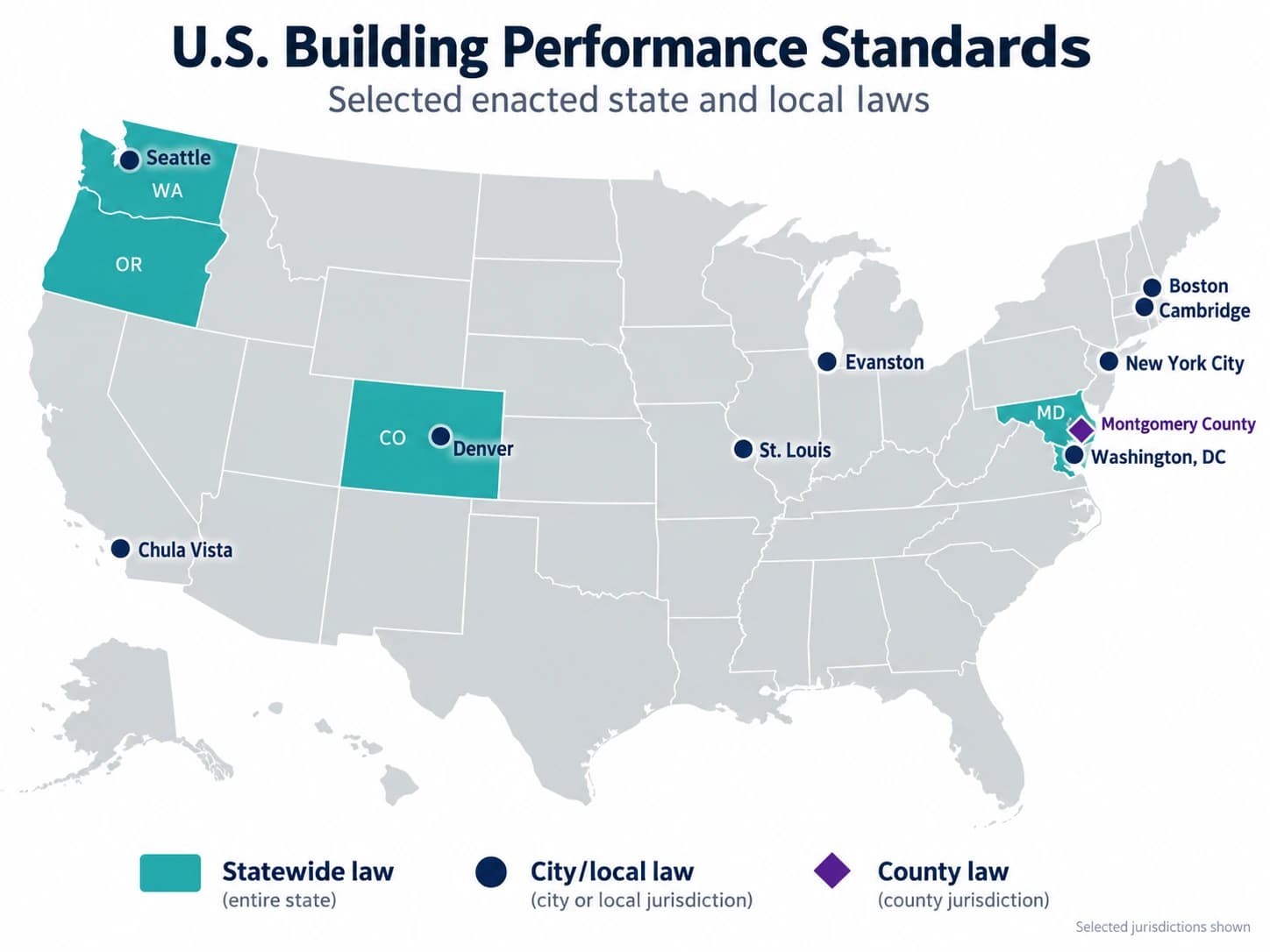
Building owners across the United States are facing a new generation of energy and emissions requirements. New York City’s Local Law 97 may be one of the best-known examples, but similar building performance standards are now in force in cities and states across the country.[1]
The laws differ in what they measure and how they define compliance. Some focus on greenhouse-gas emissions. Others set energy-use targets. Some combine efficiency, electrification and renewable-energy requirements.
But they point in the same direction: large buildings are increasingly expected not just to measure their performance, but to improve it over time.
For owners making investments today, that means thinking beyond the next compliance deadline. Building systems also need to be ready for new regulations, new energy strategies and technologies that may emerge years from now.
Different jurisdictions, same direction
Building performance standards are being implemented at both the city and state level. Here are some of the more prominent examples:
| Jurisdiction | What it covers | Main requirement | Where it’s heading |
|---|---|---|---|
| NYC – Local Law 97[2] | Most buildings >25,000 sf | GHG emissions intensity | Significantly tighter limits in 2030; net-zero trajectory to 2050 |
| Boston – BERDO 2.0[3] | ≥20,000 sf or ≥15 residential units | GHG emissions intensity | Standards tighten every five years to zero emissions in 2050 |
| Seattle – BEPS[4] | Buildings >20,000 sf | GHG emissions intensity | Targets begin 2031–35 by building size and tighten every five years toward net zero |
| Maryland – statewide BEPS[5] | Most buildings ≥35,000 sf | Direct GHG emissions + energy performance | 2030 standards; zero net direct GHG emissions by 2040 |
| Cambridge, MA – BEUDO[6] | Nonresidential ≥25,000 sf | Carbon emissions | Buildings ≥100,000 sf begin reductions in 2026 and reach net zero in 2035; smaller covered buildings follow |
| Evanston, IL – Healthy Buildings Ordinance[7] | Most buildings ≥20,000 sf | Energy, emissions and renewable-energy performance | Progressive performance standards supporting building decarbonization by 2050 |
| Washington, DC – BEPS[8] | Cycle 1: private buildings >50,000 sf | ENERGY STAR / EUI performance | Successive performance cycles intended to drive continued reductions |
| Colorado – statewide[9] | Commercial, multifamily and public buildings ≥50,000 sf | Energy-use or GHG performance | Statewide performance program targeting major reductions through 2030 and beyond |
| Denver – Energize Denver[10] | Buildings ≥25,000 sf | EUI targets | Building-specific energy-performance targets; most buildings have an interim deadline in 2028 and a final deadline in 2032 |
| St. Louis – BEPS[11] | Buildings ≥50,000 sf | Site EUI | Initial targets took effect in 2025; standards are reviewed and updated every four years |
| Oregon – statewide BPS[12] | Tier 1 commercial buildings ≥35,000 sf | EUI / ASHRAE Standard 100 | Compliance phases in from 2028 through 2030 by building size |
| Washington State – Clean Buildings[13] | Tier 1 commercial buildings >50,000 sf | EUI / Clean Buildings Performance Standard | Compliance is already phasing in from 2026 through 2028 |
Requirements and exemptions vary by jurisdiction and building type, so the table is a high-level comparison rather than compliance guidance.
What matters is the broader pattern. New York regulates carbon emissions. Denver and St. Louis focus heavily on energy use intensity. Evanston combines multiple measures. Washington and Oregon use performance standards based on established energy-management frameworks.
There is no single national standard — but there is clearly a national movement toward measurable building performance.
Compliance is becoming an ongoing process
These regulations are generally not designed around a single upgrade followed by years of doing nothing.
Targets become stricter. Compliance cycles repeat. Building performance continues to be measured.
At the same time, the technology available to owners is changing.
Heat pumps are replacing conventional heating equipment. Battery storage is becoming more practical. EV charging can create significant new electrical loads. Buildings are adding renewable generation, advanced metering and more sophisticated energy-management tools. Utilities are developing new demand-response programs and rate structures.
AI-driven optimization, predictive maintenance and new sensor technologies will add still more possibilities.
Owners therefore face two moving targets:
The requirements are changing, and the technologies available to address them are changing as well.
Your BMS should not become the limitation
Building automation already plays an important role in energy performance. HVAC schedules, setpoints, occupancy control, lighting and equipment operation can all affect how much energy a building consumes.
But increasingly, the bigger question is what happens after the system is installed.
What happens when the building replaces boilers with heat pumps? Adds batteries or solar? Installs hundreds of EV chargers? Introduces new metering? Participates in a new utility program? Or needs to meet a requirement that did not exist when the original BMS was designed?
If every change requires another standalone system or extensive reengineering, the building gradually becomes a collection of technology silos.
A BMS installed today should therefore do more than operate today's equipment.
It should provide a foundation on which tomorrow's equipment and strategies can be built.
Build an adaptable digital foundation
Bisly approaches building automation around a digital model of the building. HVAC, lighting, metering, access and other functions can operate within a common platform rather than as isolated systems.[14]
Its support for standard protocols, APIs and third-party integrations also allows additional equipment and technologies to be incorporated as the building evolves.[14]
That becomes increasingly important in a regulatory environment where nobody can say exactly what a building will be expected to do ten or fifteen years from now.
The goal is not to predict the future.
It is to make sure the building can adapt to it and take advantage of it.
Build for the requirement after the requirement
Today, an owner in New York may be thinking about Local Law 97. An owner in Boston may be focused on BERDO. In Seattle, Maryland, Colorado or Washington State, the terminology and performance metrics are different.
Tomorrow, the requirements may change again.
The same is true of technology. The best energy strategy available to a building in 2035 may involve equipment and operating models that are only emerging today.
That changes how building automation investments should be evaluated.
Reducing energy consumption and supporting today's compliance requirements matter. But an automation platform should also make it easier to integrate the next technology, the next energy strategy and the next regulatory requirement without starting over.
The future-ready building is not the one that predicts what comes next. It is the one designed to adapt when it arrives.
References
- Institute for Market Transformation, Maps and Comparisons — U.S. Building Performance Standards
- New York City Department of Buildings, Local Law 97 Greenhouse Gas Emissions Reduction
- City of Boston, Building Emissions Reduction and Disclosure Ordinance (BERDO)
- City of Seattle, Building Emissions Performance Standard
- Maryland Department of the Environment, Building Energy Performance Standards
- City of Cambridge, Building Energy Use Disclosure Ordinance
- City of Evanston, Healthy Buildings Ordinance
- District of Columbia Department of Energy & Environment, Building Energy Performance Standards
- Colorado, Building Performance Colorado / HB21-1286
- City and County of Denver, Energize Denver — Large Building Compliance Overview
- City of St. Louis, Building Energy Performance Standard
- Oregon Department of Energy, Building Energy Performance Standards
- Washington State Department of Commerce, Clean Buildings Performance Standard
- Bisly, building automation platform and digital-twin architecture.