Digital Twin and Lifecycle Data
What Developers Should Know About Intelligent Building Infrastructure
Building intelligence should not be a collection of systems added late in construction. Developers can reduce complexity and protect long-term asset value by defining the automation architecture early.
The Most Expensive Time to Design Building Automation Is During Installation
Controls are often treated as a late-stage construction package. The mechanical systems have been selected. Electrical design is substantially complete. Access control has its vendor. Lighting has another. Intercom has another. Metering may be part of a separate package. Then someone asks how all of it should work together. At that point, integration becomes a coordination exercise between systems that were never necessarily designed to operate as one.
The result can be additional gateways, custom programming, RFIs, duplicated sensors, multiple management platforms, and a large commissioning burden. Developers can avoid much of that complexity by treating intelligent infrastructure as an architectural decision rather than a collection of downstream technology purchases.
Start With Outcomes, Not Devices
The first automation conversation should not be about which thermostat or controller to buy. It should be about the building. What should residents be able to control? What should property management be able to see? Which HVAC functions need centralized oversight? How will vacant apartments be managed? How will energy consumption be measured? How should access rights change when a resident moves? What information should the owner retain after handover?
What should happen when a device fails? Which systems may need to be added in five or ten years? Once those requirements are understood, the technology architecture can be designed around them. That is a much stronger process than buying independent systems and attempting to integrate them afterward.
The Digital Twin Should Begin Before Installation
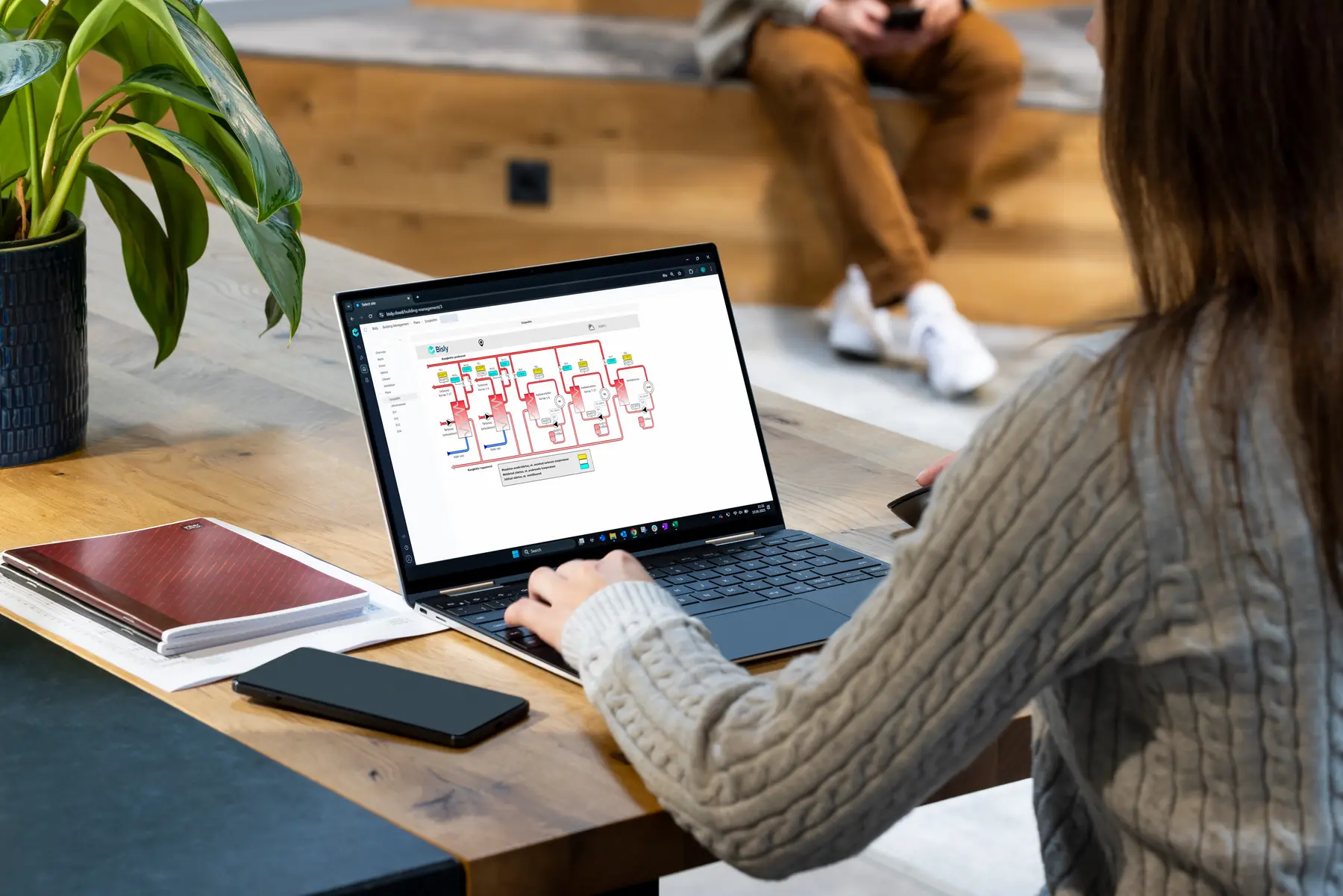
A digital twin is often described as something created after a building exists. For operational building automation, that is too late. Bisly's approach begins creating the operational model during project configuration. The building structure, rooms, automation functions, and required devices are established before the equipment is installed. That model assists with system design and hardware requirements. It then continues into installation. Physical devices are connected to their corresponding locations in the model.
The same structure ultimately becomes part of the operational building-management environment. This creates continuity across stages that are traditionally disconnected:
quotation → design → procurement → installation → commissioning → handover → operation.
Rather than recreating information during every transition, the system carries its identity forward.
Continue reading: panel-based multifamily automation.
Early Standardization Reduces Downstream Decisions
Construction projects contain thousands of decisions. Every decision made on site carries a cost. A standardized automation platform moves many recurring decisions earlier in the process. Apartment templates can be established. Control sequences can be defined. Hardware requirements can be generated. Common naming and device structures can be established. The installer then deploys against a known configuration rather than deciding how the automation system should work while standing in front of a panel.
For repetitive construction such as multifamily, this can be particularly powerful.
One Platform Can Reduce Integration Boundaries
Every system boundary introduces another coordination boundary. If HVAC, lighting, metering, access, and apartment automation use independent platforms, developers are not merely purchasing five technologies. They are purchasing the interfaces between those technologies as well. Someone must design them. Someone must program them. Someone must test them. Someone must support them when one side changes.
Bisly is designed as a unified automation environment covering multiple building functions while still supporting third-party integrations through standards such as Modbus, DALI, and APIs where appropriate. The goal is not to eliminate every third-party product. The goal is to reduce unnecessary fragmentation.
Think About the Person Who Owns the Building Five Years Later
Construction teams quite reasonably focus on completion. Owners live with the consequences much longer. After handover, staffing changes. Tenants move. Equipment is replaced. Operating strategies change. Energy regulations evolve. Software requires updates. A building automation system should therefore be evaluated not just against the commissioning specification, but against the next decade of operation. Developers should ask vendors:
- Can the system be managed remotely?
- How are software updates handled?
- Can configurations be changed without specialist programming?
- What happens if internet connectivity is interrupted?
- How is installed equipment documented?
- Can multiple buildings be managed consistently?
- Can third-party systems be integrated?
- Who provides lifecycle support?
- Can future systems be added without rebuilding the entire architecture?
These questions reveal much more about long-term value than a feature checklist.
Protect the Owner From Technical Debt
Buildings accumulate technical debt in much the same way as software. A workaround added during commissioning can remain for fifteen years. An undocumented gateway eventually becomes something nobody wants to touch. A proprietary integration may prevent a future equipment upgrade. Five separate management interfaces may require five separate service agreements. The cheapest construction decision is not necessarily the lowest-cost lifecycle decision. Developers do not need to predict every technology the building will use in 2040.
They do need to build an architecture capable of change.
Intelligent Infrastructure Is Becoming Core Infrastructure
Twenty years ago, high-speed internet was sometimes treated as a building amenity. Today, nobody designing a new multifamily property considers connectivity optional infrastructure. Building intelligence is moving in the same direction. As HVAC systems electrify, energy regulation increases, residents expect smarter environments, and property teams manage increasingly complex buildings, automation becomes more central to the asset itself.
Developers therefore have an opportunity to make the automation architecture a strategic design decision rather than a late-stage controls package. The earlier that decision is made, the more value it can create throughout the building lifecycle.
Continue reading: how Bisly reduces installation cost and errors.
Start the automation strategy before procurement
IBIS Group USA helps developers, MEP teams, and contractors design Bisly systems around the complete building lifecycle.